
IV. Husbandry at a Glance
Among the most coveted crustaceans in the modern isopod hobby, the Rubber Ducky isopod — named for the startling resemblance of its rounded, marbled body to a child’s bathtub toy — commands both considerable admiration and considerable patience from its keepers. Native to the humid limestone cave systems of northern Thailand, this species demands conditions that replicate its subterranean origins with careful attention to moisture gradients and temperature stability.
Distribution & Habitat
The Rubber Ducky isopod originates from the cave systems and rocky karst formations of Chiang Dao district in Chiang Mai Province, northern Thailand. It has been documented in humid limestone grottos at elevations between 400 and 800 metres, where leaf litter accumulation provides both moisture retention and a consistent food source.
Wild populations are subject to conservation pressure from collector interest, and responsible keepers are strongly encouraged to source only captive-bred specimens from reputable breeders. The species has not been formally described by taxonomic science and remains an sp. designation pending peer-reviewed publication.
Morphology & Identification
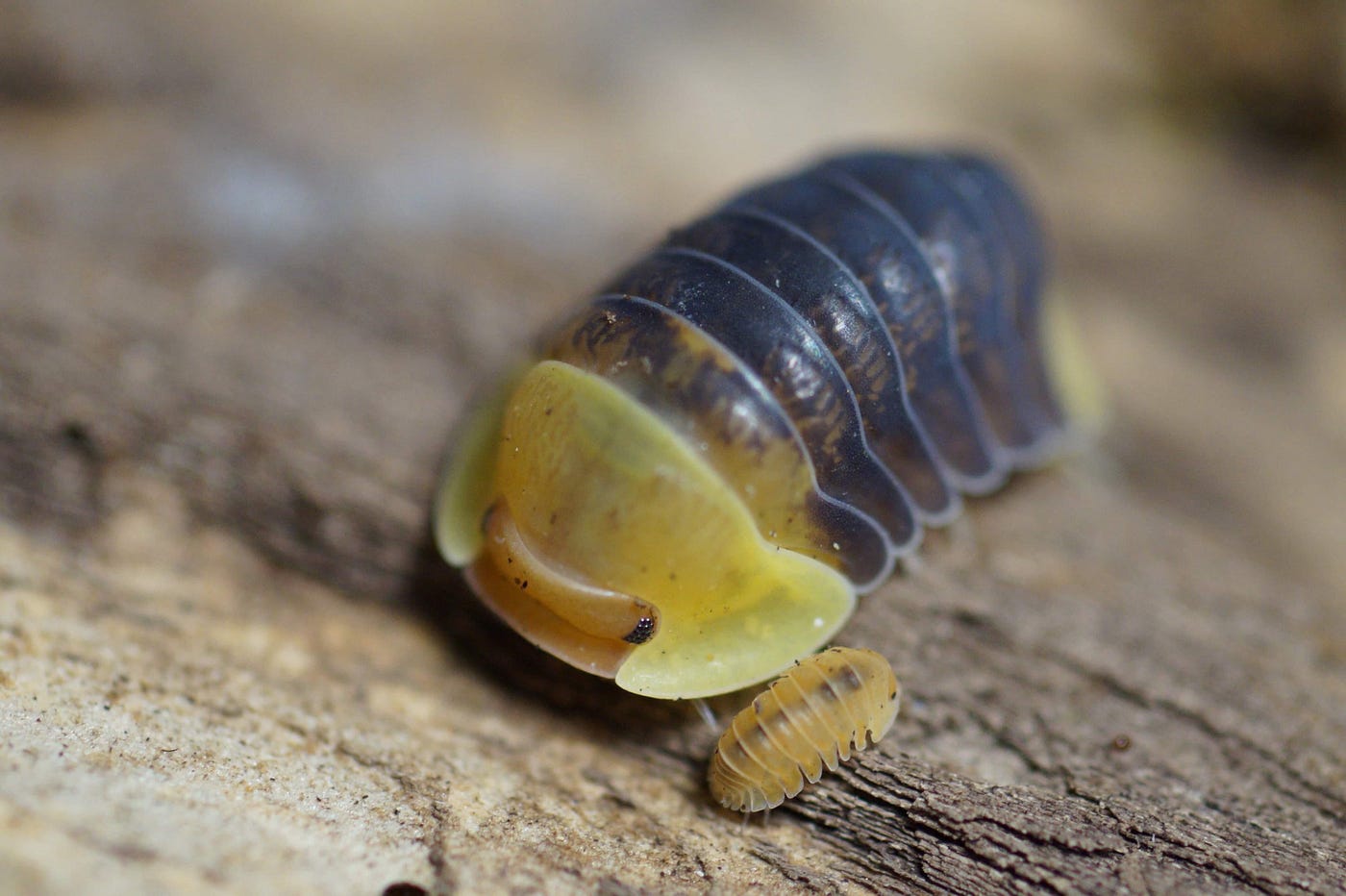
Adults are immediately recognisable by their high-domed, globose tergites — segments that arch dramatically upward, creating the rounded silhouette responsible for the species’ common name. The base colouration is a pale cream to ivory, overlaid with irregular sepia-brown marbling that varies considerably between individuals.
Females are typically larger than males and display slightly broader pleonic segments. The antennae are long relative to body size, and the pleopods — used for gas exchange — remain concealed beneath the smooth ventral surface. Juveniles (mancae) emerge from the marsupium at approximately 2–3 mm, already displaying faint pattern traces.
The Rubber Ducky is occasionally confused with Cubaris murina at juvenile stages. Key distinguishing features are the strongly convex tergite profile and the cream base colouration with brown marbling, absent in most C. murina populations.
Behaviour & Temperament
Rubber Ducky isopods are notably more retiring than many commonly kept species. Colonies are slow to establish confidence in a new enclosure, and keepers report that meaningful activity is rarely observed for the first two to three months after introduction. Patience is non-negotiable with this species.
When disturbed, adults conglobe instantly — rolling into a perfect sphere and remaining motionless for extended periods. This defensive posture is more pronounced than in most Armadillidium species, and the rounded carapace creates an almost seamless seal. Colonies kept with minimal disturbance and low foot traffic are significantly more productive.
Breeding & Reproduction
Reproduction is ovoviviparous: females carry fertilised eggs within a fluid-filled brood pouch (marsupium) located on the ventral surface. Gestation lasts approximately six to eight weeks under optimal conditions, after which mancae emerge fully formed and independent.
Avoid handling gravid females. The physical stress of conglobation when threatened can result in premature release of mancae or reabsorption of the clutch. Observe from a distance and minimise enclosure disturbance during the final two weeks of gestation.
Colour Morphs & Variants
Selective breeding has produced a small number of recognised morphs within the hobby, though the wild-type marbled cream-and-sepia pattern remains the most prevalent and widely available. Morph nomenclature in the isopod hobby is largely informal and unstandardised — photographic comparison with established reference images is recommended before purchasing named morphs at premium prices.