IV. Husbandry at a Glance
The Spanish Orange is a striking colour morph of Porcellio scaber, the common rough woodlouse — one of the most widely distributed terrestrial isopods on Earth. Its vibrant orange colouration is the result of selective captive breeding and represents an ideal entry point into the isopod hobby: forgiving, fast-reproducing, and genuinely beautiful.
Distribution & Habitat
Porcellio scaber in its wild-type form is native to Western Europe and has been introduced globally through human activity, making it one of the few truly cosmopolitan terrestrial isopods. The orange morph exists exclusively in captivity as a selectively bred line.
In the wild, P. scaber occupies a remarkable range of habitats — from coastal dunes to urban gardens, compost heaps to woodland floors — demonstrating the robust environmental tolerance that makes this species such an excellent choice for new keepers.
Morphology & Identification
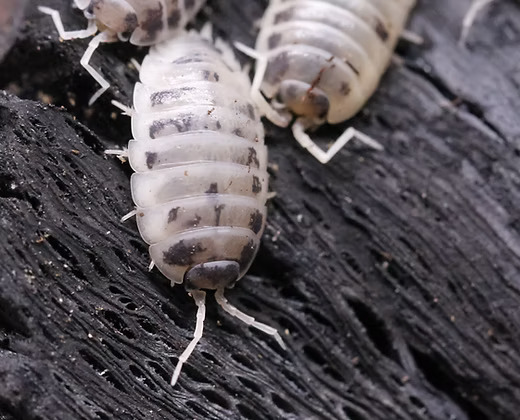
Porcellio scaber is characterised by a distinctly tuberculate (rough, granular) dorsal surface — the texture that gives the species its common name. The orange morph replaces the typical grey-brown colouration with a consistent, vivid orange across all tergites. Colouration is stable and breeds true when maintained as an isolated line.
Adults are flatter in profile than conglobating species such as Armadillidium or Cubaris, and cannot roll into a complete ball — instead curling partially when threatened.
Behaviour & Temperament
One of the most active and visible isopods in the hobby. Unlike many collector species that hide constantly, P. scaber ‘Orange’ ventures confidently into open areas, making colonies genuinely enjoyable to observe. They tolerate handling reasonably well and recover quickly from disturbance.
Colony growth is rapid under adequate conditions, making this species useful both as a display animal and as a feeder/custodian species in bioactive enclosures.
Breeding & Reproduction
Porcellio scaber breeds prolifically and is among the easiest isopods to establish. Females carry large clutches and multiple generations overlap quickly, leading to explosive colony growth within three to four months of a good starting group. A group of 20 individuals can become several hundred within a single year under optimal conditions.
Colour Morphs & Variants
The P. scaber complex has produced more captive colour morphs than almost any other isopod species, including Dalmatian (white with black spots), Calico (mixed orange and grey), Lava (deep red-orange), and various high-orange selections. These morphs can be line-bred with relative ease, making P. scaber popular with hobbyist breeders experimenting with genetics.